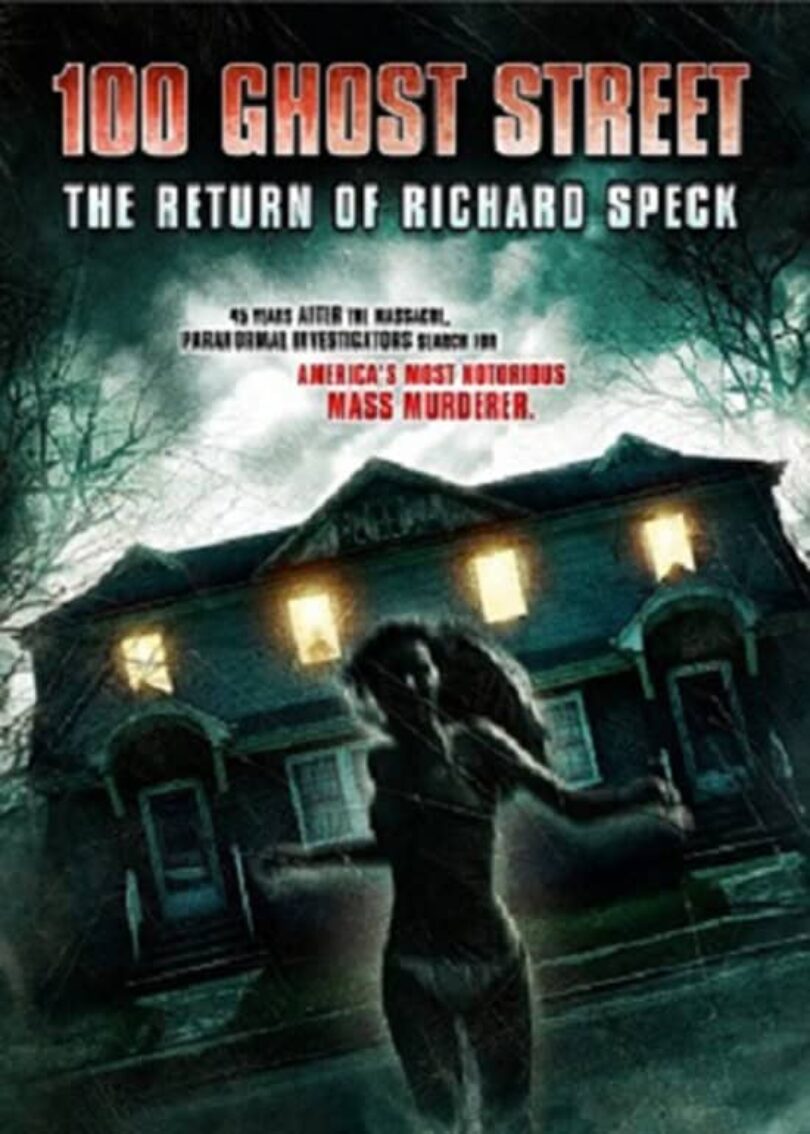
There is something uniquely uncomfortable about building a ghost story around a real crime. Not a vague “inspired by true events” disclaimer — but the actual name, the actual address, the actual victims. 100 Ghost Street: The Return of Richard Speck plants its flag squarely in one of the most disturbing mass murders in American history and dares you to find it entertaining. Whether that’s a bold creative choice or a cynical marketing move is a question the film never quite answers for you.
What I can tell you is that I expected almost nothing from this — The Asylum’s name was on the poster, the IMDb score was low, and the premise felt like a grab for notoriety. And yet. I came away more entertained than I had any right to be.
This review is an expanded and updated English translation of our original German review, first published in 2014 — yes, we’ve been at this for a while.
100 Ghost Street: The Return of Richard Speck (2012)
The Story: In 2010, a paranormal investigation crew locks themselves overnight inside the abandoned Chicago dormitory where Richard Speck murdered eight student nurses in 1966. They are looking for his ghost. They find it.
🎬 Our opinion: Lower your expectations, ignore the IMDb score, and you might actually have a decent time. The early kills arrive too fast, the characters are thin, and the editing has one baffling lapse that makes a key scene fall apart — but the atmosphere is genuinely creepy, the clicking sound design works well, and as Asylum found footage goes, this is closer to competent than catastrophic.
Director: Martin Wichmann · Cast: Jackie Moore, Jennifer Robyn Jacobs, Jim Shipley, Hayley Derryberry, Tony Besson
Watch it
Powered by JustWatchWhat 100 Ghost Street Is About
The night of July 13, 1966 is one of the darkest in Chicago’s history. Richard Speck — a 24-year-old drifter with a criminal record, a drinking problem, and “Born to Raise Hell” tattooed on his forearm — broke into a townhouse at 2319 East 100th Street in the South Deering neighbourhood. The building served as shared housing for student nurses at the South Chicago Community Hospital. Nine women were inside. Over the course of several hours, Speck bound them with strips torn from bedsheets, took them to separate rooms, and killed eight of them by stabbing, strangulation, or both.
The ninth woman, Corazon Amurao, survived by rolling under a bed and staying there until dawn. It was her testimony that identified Speck, whose fingerprints were matched to records already on file. He was caught, tried, and sentenced — first to death, then to multiple life terms after the Supreme Court ruled capital punishment unconstitutional in 1972. Richard Speck died of a heart attack in prison on December 5, 1991, the day before his 50th birthday.
The film picks up the thread forty-five years later. A paranormal investigation crew — the kind that makes reality TV shows about haunted buildings — has arranged to spend the night inside the long-abandoned dormitory, hoping to make contact with Speck’s ghost. They have cameras, they have equipment, and they have absolutely no idea what they are walking into. The footage, we are told, was later recovered and released by police. The crew was not.
The 100 Ghost Street Trailer
Review: 100 Ghost Street (Spoiler-Free)
Let’s address the obvious thing first. This is an Asylum production — the studio that built an empire on mockbusters and low-budget VOD horror — and the IMDb score of 3.8 will send most people running before the first frame. I almost didn’t watch it myself.
But the score is, I think, a little unfair. Not because this is a great film — it isn’t — but because it is a considerably more watchable one than its reputation suggests.
Director Martin Wichmann makes one decision early on that separates this from the typical paranormal investigation template: he kills people fast. Where most films of this type spend their first act slowly building dread through bumps and shadows and characters looking nervously at each other, 100 Ghost Street establishes the stakes almost immediately. The crew barely has time to set up their equipment before things go very wrong. The intention, clearly, was to inject pace and urgency from the start.
It half works. The early deaths do create momentum — but they also mean we have spent almost no time with these people before they start dying. Horror lives and dies on the audience’s investment in its characters, and here that investment never really has time to form. When the first body drops, I felt nothing in particular. Which is a problem.
After that opening burst, the film settles down — and this is actually where it finds its footing. The abandoned building is a genuinely effective location, all peeling corridors and institutional grimness. And the ghost’s signature — a distinctive clicking, clattering sound that seems to come from everywhere at once — is one of the more effective sound design choices I’ve encountered in micro-budget found footage. It’s simple and it works. There were moments where I felt genuine unease, which is more than I can say for plenty of more expensive productions.
The cast is better than you’d expect. Jennifer Robyn Jacobs and Jim Shipley in particular bring a natural chemistry to their scenes that lifts the material around them. Jackie Moore, playing the documentary host, is less convincing — stilted in the expository sequences — but when the genuine fear kicks in later, most of the cast rises to meet it.
Then there is the edit. There is one scene — involving a woman locking herself in a room and hiding under a bed while the door slowly opens — that simply ends. Cut to black. Next scene: the same woman, walking down a corridor, apparently fine. No explanation. No transition. The scene as filmed was apparently considerably more graphic, and what reached the final cut has been trimmed in a way that makes it narratively incoherent. It’s a jarring lapse in an otherwise functional film, and it’s the moment you feel most clearly that something went wrong somewhere in post-production.
One note worth flagging: some versions of this film circulating on physical media appear to feature an apparition of Speck that is absent from others. The version I watched did not include this. If you’ve seen a different cut, your experience may vary.
Did you know?
The film quietly gets the history wrong — and the real story is even darker. The film states that Speck murdered seven nurses that night with one survivor. In reality, there were nine women in the dormitory: eight were killed, and the ninth — Corazon Amurao, a Filipino exchange student — survived by hiding under a bed for hours until Speck left. It was her testimony that led directly to his capture. Speck had lost count of his victims. As for the prison years: in 1996, a videotape made inside Stateville Correctional Center surfaced and was broadcast on television. It showed Speck — who had noticeably changed physically in prison — laughing, discussing the murders, and showing no remorse whatsoever. The tape caused national outrage and remains one of the most disturbing postscripts to an already disturbing case.
Verdict
100 Ghost Street: The Return of Richard Speck is not a good film by any conventional measure. The characters are underdeveloped, the early pacing is misjudged, and one editing decision borders on inexplicable. But it has atmosphere, a genuinely effective sound design trick, and enough momentum to hold your attention once it finds its rhythm.
For a late-night, low-expectations watch, you could do considerably worse. And you probably will, if you keep working through the found footage catalogue.
Where to Watch 100 Ghost Street: The Return of Richard Speck
Powered by JustWatchSimilar Movies to 100 Ghost Street
If the combination of paranormal investigation, haunted location, and true crime backstory worked for you, these are worth your time — most of them considerably more polished, some of them genuinely excellent.
Grave Encounters (2011) — The obvious reference point, and the better film. A ghost hunting TV crew locks themselves overnight in an abandoned psychiatric hospital. Shares almost exactly the same DNA as 100 Ghost Street but executes it with sharper writing, a better escalation of dread, and one of the more unsettling location-based concepts in found footage. If you haven’t seen it, start here.
Hell House LLC (2015) — Another haunted building, another crew, another night they won’t survive. What makes Hell House LLC stand out is how carefully it builds its mythology across multiple “found” recordings, and how effectively the clown mannequins are deployed. Slow burn done right.
The Atticus Institute (2015) — A mockumentary rather than pure found footage, but thematically adjacent: a real institution, a real case, something that really shouldn’t have been investigated. More cerebral than 100 Ghost Street, considerably more unsettling.
Cropsey (2009) — Not fiction, but the documentary that sits closest in spirit to what 100 Ghost Street is attempting. A real urban legend, a real crime, a real location on Staten Island. If the true crime angle interested you more than the ghost angle, this is the one to watch next.