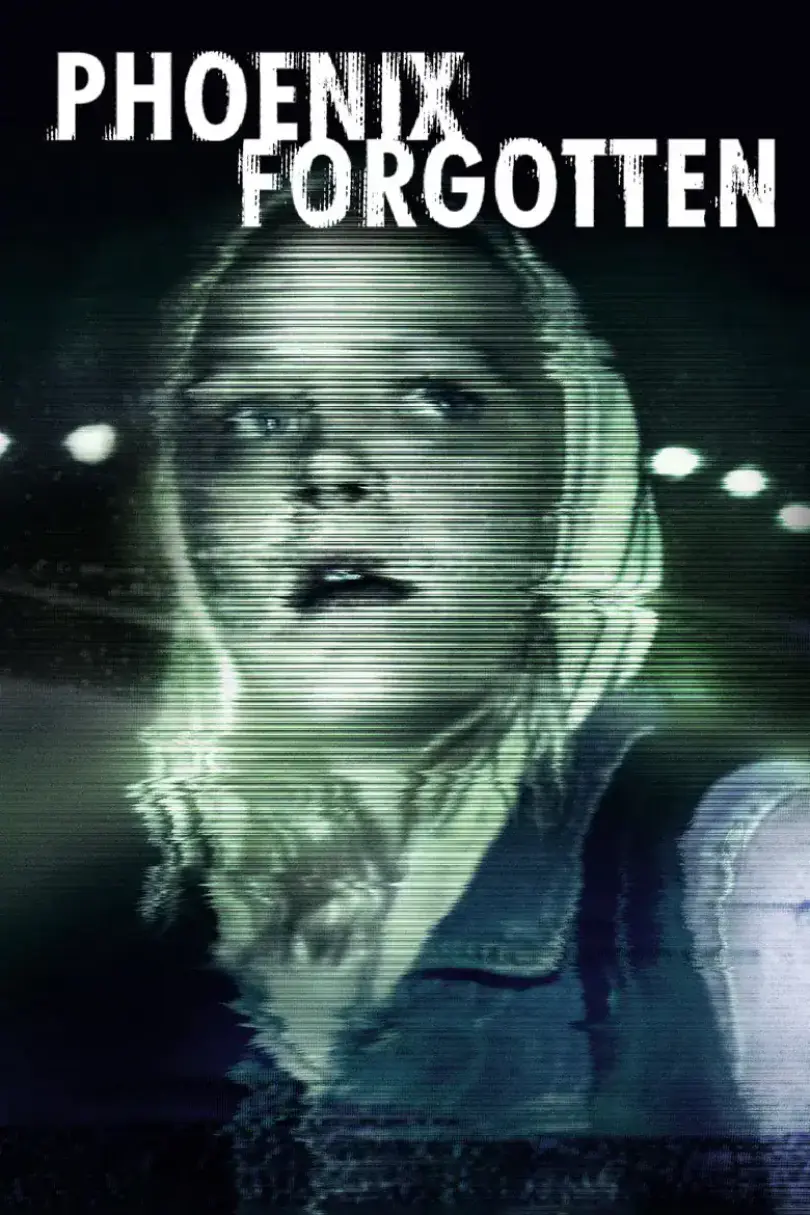
On March 13, 1997, thousands of people across Phoenix, Arizona, witnessed something in the sky that nobody has satisfactorily explained since. A triangular formation of lights — silent, enormous, moving slowly — passed over the city for several hours. The US Air Force eventually attributed it to flares. Nobody who saw it believed them. The Phoenix Lights remains one of the most widely documented and thoroughly unresolved UFO events in American history.
It is, in other words, exactly the kind of material found footage was made for. Phoenix Forgotten knows this. Its first two acts are a quiet argument for why the format still works. Its final act is a reminder of the risks of promising more than you can deliver.
Phoenix Forgotten (2017)
The Story: In 1997, three teenagers disappeared in the Arizona desert shortly after the Phoenix Lights appeared in the sky above their city. Twenty years later, Sophie Bishop returns to Phoenix to make a documentary about her brother Josh — one of those three — and discovers footage that nobody has ever seen. The tape runs for 45 minutes. Then it stops.
🎬 Our opinion: A slow-burn hybrid that earns its atmosphere and then stumbles at the finish line. The opening is well-constructed, the found footage middle section is genuinely tense in places, and the ending is… okay. With Ridley Scott producing, you expect the payoff to match the buildup. It doesn’t quite get there.
Director: Justin Barber · Cast: Florence Hartigan, Luke Spencer Roberts, Chelsea Lopez, Justin Matthews
Watch it
Powered by JustWatchWhat Phoenix Forgotten Is About
Sophie Bishop was six years old on the night of March 13, 1997 — her birthday. Her older brother Josh was filming the party when the lights appeared in the sky. He turned the camera upward. The footage is remarkable. The explanation, when it came from the Air Force, wasn’t convincing to anyone who’d been there.
Shortly afterwards, Josh and two friends — Ashley and Mark — drove out into the desert to investigate. They took a camera. They were never found.
Twenty years later, Sophie returns to Phoenix to make a documentary about her brother’s disappearance. She interviews witnesses, revisits the family home, tracks down people who knew Josh. And then, in a storage unit belonging to Josh’s former teacher, she finds a tape. Unlabelled. Never reviewed. Containing 45 minutes of footage from that night in the desert.
The Phoenix Forgotten Trailer
Review: Phoenix Forgotten (Spoiler-Free)
The best thing about Phoenix Forgotten is its first half. Justin Barber structures the film as a proper documentary — not a parody of one, not a winking pastiche, but something that genuinely feels like the kind of true-crime investigation series that dominates streaming. Sophie’s interviews are well-handled. The reconstruction of events around the Phoenix Lights is convincing. The period detail — home video footage shot on camcorder in 1997, complete with date stamps and analog grain — is done with enough care that it stops feeling like an aesthetic choice and starts feeling like evidence.
The found footage section, when it arrives, earns its atmosphere through economy rather than spectacle. Three teenagers in a desert at night, with a camera and a theory, is exactly the right scale for this format. The landscape does a lot of the work — the Arizona desert at night is genuinely disorienting, the darkness absolute, the distances impossible to read. When strange things begin to appear at the edges of the frame, the film is smart enough to keep them there. You’re straining to see, which is exactly where found footage wants you.
The performances from the three teenagers — Luke Spencer Roberts as Josh, Chelsea Lopez as Ashley, Justin Matthews as Mark — are naturalistic in the way that matters. They talk like people, not like characters. Their dynamic feels lived-in. When things start to go wrong, their reactions feel plausible rather than performed.
And then the ending arrives. I won’t describe it, but I’ll say this: the film had been doing something intelligent with restraint, and the final minutes abandon it. What had been a mystery carefully held at arm’s length is suddenly, abruptly resolved — or rather, replaced with something that asks you to accept a great deal on very short notice. The tonal shift is jarring, the runtime doesn’t allow for what it’s attempting, and you leave the film with the specific frustration of something that was working right up until the moment it wasn’t.
It’s a shame, because the bones of a genuinely good film are here. The Phoenix Lights are the right subject. The hybrid format is handled with more intelligence than most. The desert is terrifying. If Barber had trusted the darkness a little longer — let the film end on ambiguity rather than revelation — Phoenix Forgotten might have been something to remember.
Did you know?
The Phoenix Lights really happened. On March 13, 1997, thousands of people across Phoenix witnessed a massive triangular formation of lights moving silently across the sky. The US Air Force said they were flares. Nobody who was there believed them. It remains one of the most widely documented UFO events in history — and the perfect true-crime hook for a found footage film.
Ridley Scott produced it. The film is the debut of director Justin Barber, but came with serious backing — Scott Free Productions, The Maze Runner‘s Wes Ball and T.S. Nowlin, and a post-production process where the film was shot digitally, transferred to VHS, and converted back to digital just to get the authentic 1997 home video look. Horror director Mike Flanagan has also named it as one of his favourite horror films.
Verdict
Phoenix Forgotten is a film of two halves, and the first half is considerably better than the second. The setup is confident, the atmosphere is earned, and the found footage section delivers genuine unease. The ending lets all of that a little down — it’s not bad, but somehow i was expecting more than what actually happened.
Worth watching for the desert footage and the atmosphere it builds. Just know going in that the ending won’t match the buildup — and with Ridley Scott’s name on it, that gap feels bigger than it should.
Where to Watch Phoenix Forgotten
Powered by JustWatchSimilar Movies to Phoenix Forgotten
If the real-event found footage angle is what drew you in — the idea that the footage exists, that something really happened out there — these films work the same territory with varying degrees of success.
The Blair Witch Project (1999) — The film Phoenix Forgotten is most indebted to, and the standard against which it can’t help being measured. Three people, a camera, a forest, and something that stays off-screen throughout. The restraint that Phoenix Forgotten almost manages is something Blair Witch sustains for 81 minutes without blinking.
Skyman (2020) — Daniel Myrick — co-director of The Blair Witch Project — returns to found footage with a UFO film about a man who encountered something as a child and has been waiting for it to return ever since. Quieter and stranger than Phoenix Forgotten, and more interested in what belief does to a person than in the thing being believed in.
Alien Abduction (2014) — A family on a camping trip in North Carolina encounters something in the mountains. Like Phoenix Forgotten, it’s built around a real local legend — the Brown Mountain Lights — and uses the single-camera format to keep the threat credibly ambiguous for most of its runtime.
Lake Mungo (2008) — Not about UFOs, but shares the same hybrid documentary-found footage structure and the same commitment to using real-feeling talking heads to build dread before the footage itself arrives. Handles the balance between mystery and revelation considerably better than Phoenix Forgotten manages.