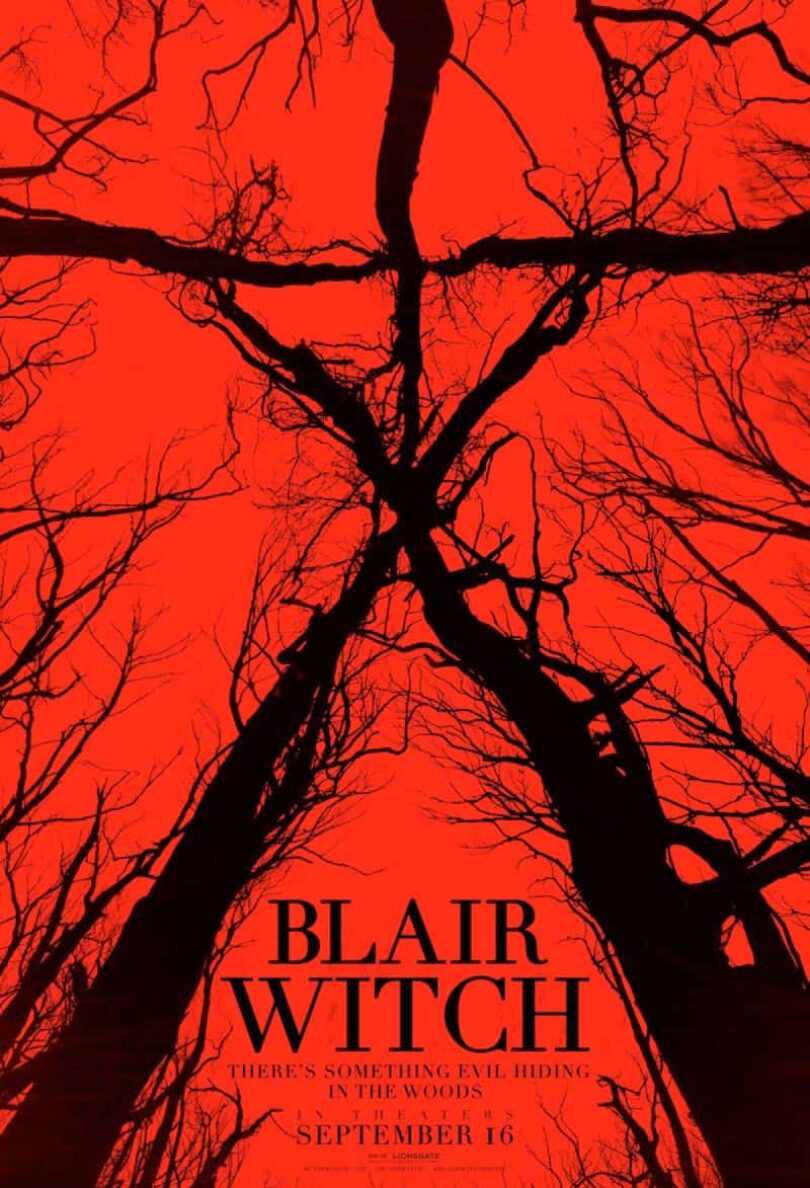
Seventeen years. That’s how long it took for the Black Hills Forest to get a worthy successor. Not Book of Shadows — let’s agree to never speak of that again — but a genuine continuation of what Daniel Myrick and Eduardo Sánchez started in 1999. When Adam Wingard and Simon Barrett were handed the keys to one of found footage’s most sacred properties, the expectations were enormous. And complicated. Because the original Blair Witch Project isn’t just a film — it’s the film that made the genre what it is. Anything wearing that name had better earn it.
The good news: it mostly does.
This review expands on our original German review from 2016 — updated and rewritten for our English audience.
Blair Witch (2016)
The Story: Twenty years after Heather Donahue vanished in the Black Hills Forest, her younger brother James discovers a YouTube video that he believes shows her — still alive, somewhere in those same woods. With his friends Ashley and Peter, and documentary filmmaker Lisa, he heads to Burkittsville. Two local residents claim to know where the footage was found. They offer to guide them in. It goes exactly as well as you’d expect.
🎬 Our opinion: A confident, genuinely frightening sequel that brings new ideas to a legendary framework. It’s more action-driven and technically ambitious than the original — which costs it some of the raw authenticity that made the 1999 film so effective — but Wingard knows how to build dread, and the final act is among the most intense in recent found footage history. Not a replacement. A worthy companion.
Director: Adam Wingard · Cast: James Allen McCune, Callie Hernandez, Brandon Scott, Corbin Reid, Valorie Curry, Wes Robinson
Watch it
Powered by JustWatchWhat Blair Witch (2016) Is About
James Donahue was a child when his sister Heather disappeared into the Black Hills Forest in 1994. He’s spent his entire life with the uncertainty of it — no body, no explanation, just footage recovered from the woods and a legend that’s never quite let the town of Burkittsville move on.
Then a YouTube video surfaces. Grainy, disorienting footage shot inside a house deep in the forest. And in one frame, James sees something that convinces him Heather might still be alive. He can’t not go.
He recruits his friends Peter and Ashley, along with film student Lisa who’s working on a documentary about the search. A tip from two local residents — Lane and Talia, who claim to have found the original footage — gives them a starting point. The six of them head into the woods together. What they find there is something that the original film could only gesture towards. This time, Blair Witch shows its hand.
The Blair Witch (2016) Trailer
Review: Blair Witch (2016) — Spoiler-Free
There is no found footage film with more to live up to than this one. The 1999 original didn’t just launch a genre — it redefined what horror could do with almost nothing: no monster, no score, no resolution, just three people walking into the dark and not coming back. Any sequel carries that legacy whether it wants to or not.
Wingard’s approach is smart: don’t try to replicate the original. Lean into what’s changed. In 2016, people don’t just bring one camera into the woods — they bring drones, ear-mounted clip cameras, GoPros, DSLRs. The expanded equipment gives the film more visual range than any found footage film in the franchise’s history, and Wingard uses it well. There are angles here — a drone rising above the treeline at dusk, a corridor lit only by a head-mounted camera catching fragments of movement — that are genuinely striking. The film is more cinematic than its predecessor, and for much of the running time, that works in its favour.
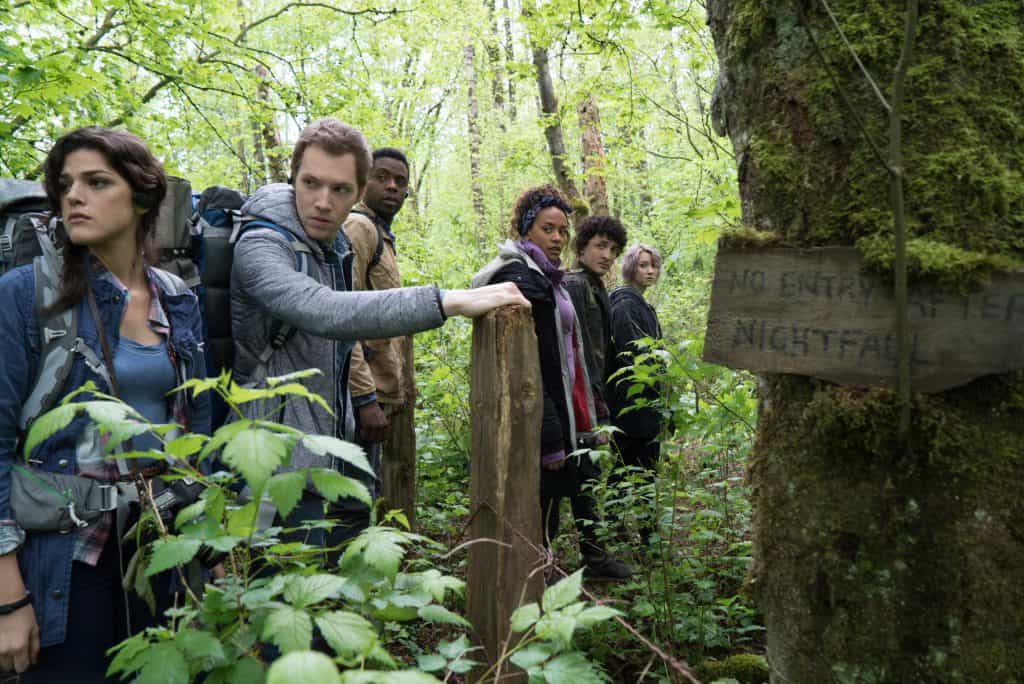
The atmosphere, too, is exactly right. That peculiar, gnawing unease that made the original so effective — the sense that the forest itself is wrong, that something in it is watching and waiting — returns almost immediately. The early scenes in the woods are tense in a way that doesn’t depend on jump scares or sudden loud noises. Just trees. Just darkness. Just the growing certainty that these six people are not going to find their way out.
The cast helps enormously. All six actors sell their fear convincingly — no one is calculating their paycheque, everyone is genuinely scared — and the film does something the original didn’t quite do, which is spend time establishing the relationships before everything falls apart. You care about these people. Which makes what happens to them considerably worse.
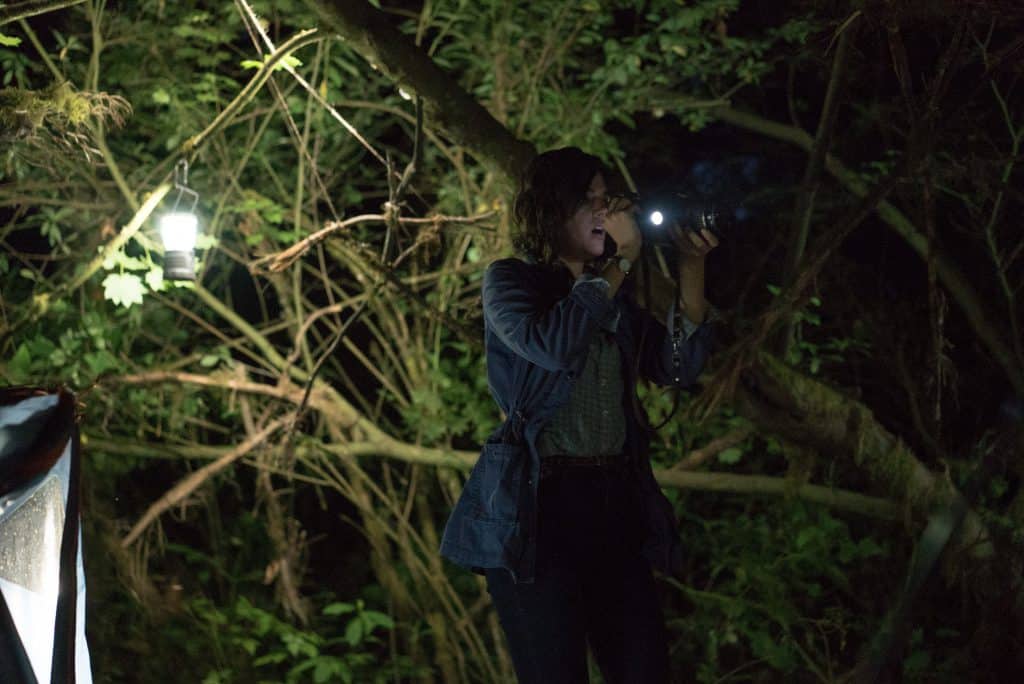
New ideas arrive steadily, and I won’t detail them here — the less you know going in, the better. What I’ll say is that Wingard and Barrett introduce elements that open up the Blair Witch mythology in interesting directions. Who is the witch? What is the forest? What does it want? Blair Witch 2016 raises new questions rather than answering old ones, which feels like the right instinct. A legend doesn’t work once you’ve explained it.
The film’s one genuine weakness — and it is a meaningful one — is credibility. The original’s genius was its plausibility: three students, one camera, no crew. Here, the sheer volume of equipment strains the found footage conceit. Multiple synchronised angles, audio from one camera laid over footage from another, a drone that apparently survived the entire ordeal — at a certain point, the invisible editor behind the film becomes visible, and the illusion cracks. This is a common problem with later-generation found footage, but it’s felt more acutely here because the 1999 film set the bar so high for internal logic.
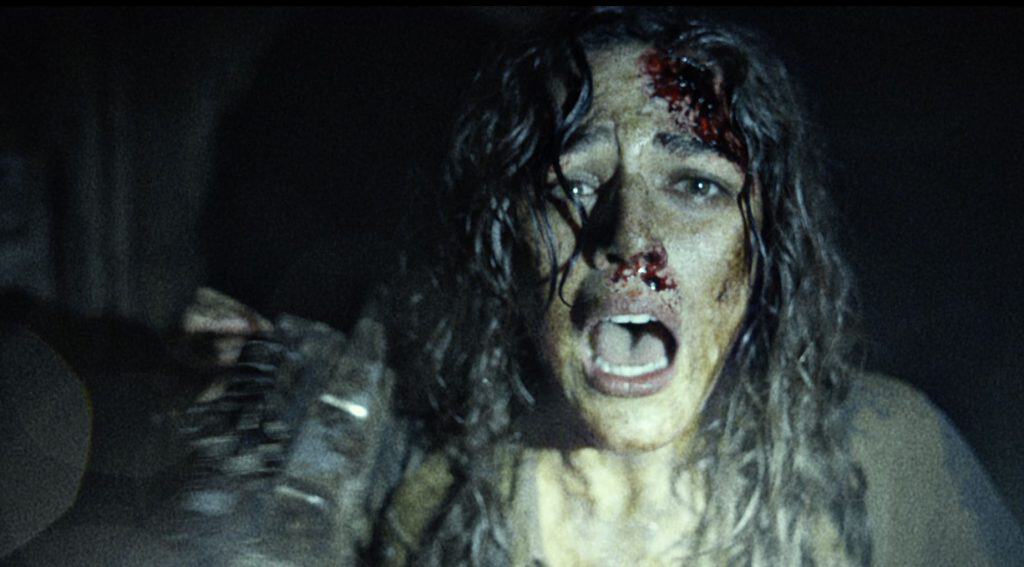
The final act, however, largely makes you forget the wobble. The last twenty minutes of Blair Witch are among the most relentlessly intense sequences in recent found footage memory — chaotic, terrifying, and building to a confrontation with something that the original film wisely kept off-screen. Whether Wingard shows too much is a debate the internet has been having since 2016. My view: he earns it. The 89 minutes disappear.
Did you know?
The best-kept secret in recent horror marketing. For over two years, Adam Wingard and Simon Barrett shot and promoted their Blair Witch sequel under the entirely fake title The Woods — complete with fabricated Kickstarter campaigns, fake festival buzz, and promotional materials that made it look like an unrelated independent horror film. Cast and crew members attending the world premiere at the 2016 San Diego Comic-Con were required to use aliases to prevent anyone from guessing the film’s true identity before the screening.
As the audience filed out into the lobby, every single The Woods poster had been switched to Blair Witch. The reaction, by multiple accounts, was audible. The film was made on a budget of $5 million and earned $45.2 million worldwide — a respectable return, though considerably below the extraordinary profitability of the 1999 original, which grossed $248 million on a budget of roughly $60,000. The film was shot not in Maryland but in the forests of British Columbia, Canada, and the infamous Blair Witch house was rebuilt on a sound stage.
Verdict
Blair Witch (2016) is a better sequel than the franchise deserved, and a stronger film than its 5.0 on IMDb suggests. It doesn’t surpass the original — nothing could, and nothing should try — but it brings genuine craft, genuine scares, and a final act that will stick with you. The credibility issues are real, and purists will feel them. But taken on its own terms, as a loud, frightening, well-directed piece of genre filmmaking, it delivers.
If the original is the film that kept you out of the woods, this one will remind you why.
Where to Watch Blair Witch (2016)
Powered by JustWatchSimilar Movies to Blair Witch (2016)
If you’ve made it through the Black Hills Forest twice and you want more of the same — atmospheric dread, found footage, something in the dark that you never quite see — these are the films worth queuing up next.
The Blair Witch Project (1999) — If you haven’t seen it, stop reading and go watch it now. If you have: go back. It rewards revisiting in a way that most horror films don’t, and watching it before or after the 2016 sequel is the ideal way to experience both. The original is slower, quieter, and more frightening than anything that came after it.
Grave Encounters (2011) — A ghost-hunting television crew locks themselves into an abandoned psychiatric hospital and discover the supernatural has opinions about that decision. One of the best found footage films of the 2010s, with a sense of escalating dread that shares a lot of DNA with the Black Hills films.
The Tunnel (2011) — A news crew goes beneath the streets of Sydney in search of a government cover-up. What they find is worse. Australian found footage at its best — restrained, atmospheric, and genuinely scary without resorting to a single jump scare.
Hell House LLC (2015) — The closest contemporary comparison in terms of tone. A haunted house attraction in an old hotel, a documentary crew piecing together what went wrong on opening night, and an atmosphere of creeping wrongness that builds from the very first scene. If Blair Witch worked for you, this will too.
Exists (2014) — Eduardo Sánchez, co-director of the original Blair Witch Project, returned to found footage with a Bigfoot film shot in the Texas woods. Louder and more creature-focused than anything in the Blair Witch series, but the forest dread is recognisably his, and it’s a better film than its reputation suggests.