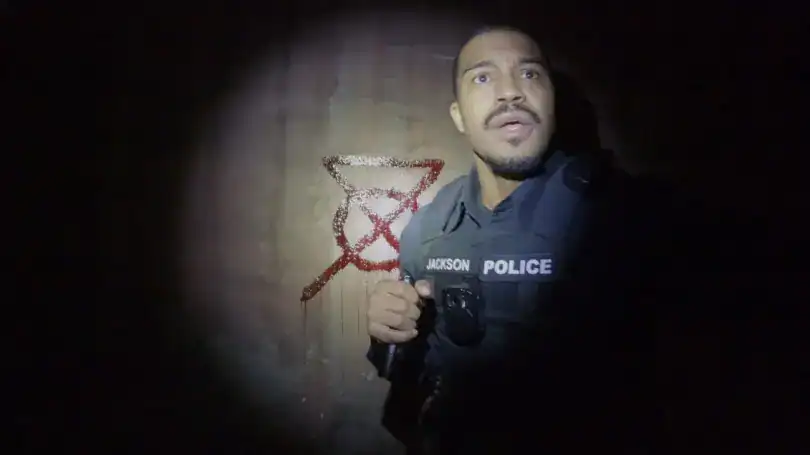
I watched Bodycam expecting a tight, well-shot found footage horror. What I got instead was a first act I loved and a back half that kept adding questions faster than it answered them. By the time the credits rolled, I had more “wait, what?” moments than I’ve had with any found footage film in a while — and judging by how many people are searching for an explanation, I wasn’t the only one.
This article is my attempt to actually untangle it: what the Underman is, what “the debt” means, whether Bryce is really dead, what Jerome did to deserve his fate, and who Neisha is and why she shows up at the end. I’ve pulled together everything the film shows on screen plus what the cast, crew, and other critics have said about it, and laid it all out as clearly as I can.
⚠️ Full spoilers from here. If you haven’t watched Bodycam yet, stop, watch it — it’s only 75 minutes — and come back. Our spoiler-free review is here.
What Happens in Bodycam — Quick Recap
Quick refresher before we get into the ending. Officers Bryce and Jerome respond to a domestic disturbance call in Henderson, Jerome’s home neighborhood. Inside, Bryce shoots an entranced man who lunges at him — not realizing the man is holding a baby, who dies too. The baby’s mother slits her own throat in front of them, muttering one word first: “the Underman.” Panicked about the fallout, Bryce talks Jerome into covering it up — staging the scene and erasing the bodycam footage. That’s where things start unraveling.
The Underman & the “Debt” — What Is It Exactly?
The film never explains itself out loud. It just keeps repeating one line, from different mouths, until you understand it’s not a threat — it’s a rule.
“The Underman” isn’t a name the film invents casually — it’s what the dying mother whispers right before she takes her own life, and it’s the word that sends Esposito running the moment she hears it. Once Bryce and Jerome start paying attention, they realize the whole neighborhood already knows the name. It’s just not something anyone outside Henderson was ever meant to hear.
Here’s what the film establishes about it:
It’s an entity, not a person. The Underman isn’t a cult leader or a human cult member — it’s presented as a demonic, supernatural presence that has attached itself to this specific stretch of Henderson, centered on the hole in the cellar floor. Multiple people in the neighborhood — the “tweakers” Bryce and Jerome keep running into — are already under its influence before the film even starts.
It runs on exchange, not random violence. The film repeats a version of the same warning throughout, spoken by different entranced locals at different points: “You take something from us, we take something from you.” This isn’t a threat. It’s closer to a rule — almost a contract. The Underman doesn’t just attack people. It responds to what’s taken from it, and it responds in kind.
Bryce’s shooting is what set it off. The man Bryce killed, and the baby he was carrying, weren’t just unlucky bystanders — they belonged to the Underman’s fold. The mother’s suicide immediately after is the first “payment” the film shows: a life for the lives just taken. Everything that happens for the rest of the night is the Underman collecting the rest of what it believes it’s owed.
It spreads through people, not just the hole. Entranced locals — sometimes called “tweakers” by Bryce dismissively — act as its extensions throughout the neighborhood. Later, Esposito and eventually Bryce himself join that same group: not dead, not exactly alive, just absorbed into whatever the Underman is.
It has history with this family already. Ally, Jerome’s mother, clearly knows more about the Underman than she’s willing to say outright. That’s not incidental — as we’ll get into later in this article, the Underman’s connection to the Jackson family didn’t start on this night.
The simplest way to think about it: the Underman is less a monster you fight and more a debt collector you can’t out-negotiate. Every choice Bryce and Jerome make after the shooting — the cover-up, the lies, the threats — just adds more to a bill that was already opening the moment the gun went off.
Here’s exactly who paid what, and to whom:
The Ending Explained — The Hole, the Reunion, and Ally’s Arrival
Here’s the final act, in the order it actually happens.
Bryce unravels. After Tommy’s death, Bryce is convinced the Underman has taken Michelle in return for everything he’s done. His nose starts bleeding, uncontrollably, every time the entity’s influence is close. He and Jerome go to his house and find the occult symbol drawn in blood on his own front door. Inside, Michelle is gone. Esposito is there instead — tied to a chair. When they free her, she starts bleeding from the mouth and speaks back to them in a voice that isn’t hers anymore.
→ The nosebleeds aren’t random body horror — they’re the film’s way of marking Bryce as “claimed.” From here on, every escalation is the debt closing in on him specifically.
Bryce goes back out looking for answers. Convinced the Underman took his wife because of what he did, Bryce forces Tommy — the same “tweaker” who’s been repeating the warning all night — into a building at gunpoint. Tommy leads him to a room numbered 514, the same number as Bryce’s own police callsign. Bryce, spooked and out of patience, shoots him.
→ The room number matching Bryce’s callsign isn’t a coincidence — it’s the Underman showing Bryce it already knows exactly who he is. Killing Tommy here isn’t self-defense like the first shooting. It’s Bryce actively adding to his own debt.
Bryce sees Michelle — or thinks he does. Suffering another nosebleed, Bryce has a vision of the dead mother cradling her baby in a bathroom. It disappears the moment Jerome walks in. Then Bryce hears what he believes is Michelle’s voice, calling him to the roof. Jerome follows and finds him alone, cradling nothing, insisting he’s found his wife dead.
→ These visions are the Underman’s method, not a side effect. It doesn’t need to attack Bryce directly — it just needs to convince him his wife is already gone.
Bryce shoots himself. Right there on the roof, in front of Jerome. His body falls and lands on the hood of their patrol car. When Jerome goes back down to check, Bryce’s body is gone.
→ The body disappearing is the tell that this isn’t a normal death. Something takes him — literally — before Jerome can even process what happened.
Jerome can’t leave. He tries to drive away from Henderson. It doesn’t matter which direction he goes — reality keeps looping him back to the same house. He calls his mother. Ally warns him not to go back inside, and tells him he’s stronger than “him” — the Underman. The call cuts out before she can say anything else.
→ The spatial loop confirms the debt isn’t optional. Jerome tried to walk away from what he did; the film makes clear that was never actually on the table.
Jerome goes back in anyway. He doesn’t have a choice left. Music draws him down into the hole in the cellar, into a deeper chamber below the house. There, he finds Bryce — alive in some sense, gunshot wound and all, speaking in the Underman’s voice — delivering Michelle’s baby while a group of entranced locals watch in a trance.
→ Bryce “delivering” Michelle’s baby, still visibly dead, is the clearest image the film gives of what being taken by the Underman actually looks like — a body still moving, doing something, with nothing human left steering it.
Neisha appears. Jerome’s dead sister steps forward from among them, possessed like the rest, and tells her brother they can be a family again. We’ll get into who she actually is and what this means in the next section — but this is the moment the film reveals she’s part of the Underman’s fold too.
Ally arrives too late. Desperate, she brings two officers — Sergeant Dobson and Officer Malone — to the house to pull her son out. They find Jerome standing over the hole, already entranced, already speaking in a voice that isn’t his own. Neisha rises from the hole behind him. The group tries to leave. The entranced locals block every exit.
→ Ally coming to save Jerome is what actually costs her. She didn’t owe the Underman anything herself — her only “debt” is loving someone who did.
The Underman takes all three. Ally, and both responding officers, are dragged away by unseen forces along with Jerome. The last footage suggests this isn’t an ending — it’s the Underman’s reach simply getting wider.
The Fate of Every Character in Bodycam, Explained
Too confusing? Here is a recap of what happens to whom:
Is Bryce Dead? His Fate Explained
Short answer: yes, physically — but the film is deliberately vague about what “dead” means for him after that.
Bryce dies exactly the way it looks on screen: he shoots himself on the roof, and his body falls onto the patrol car below. There’s no ambiguity about that part.
What happens next is where it gets stranger. His body disappears from the hood of the car almost immediately. When Jerome encounters him again underground, Bryce is walking, talking, and delivering a baby — all while still visibly carrying the gunshot wound that killed him, and speaking in a voice that isn’t his.
The most consistent reading across critics and recap sites is this: Bryce is dead in every way that matters to him as a person, but his body has been claimed and reanimated by the Underman as a vessel. He’s not a ghost, and he’s not really “alive” in any recoverable sense — he’s closer to a puppet. The film’s own internal logic supports this: it’s the same thing that happened to the mother in the opening scene, and the same thing that eventually happens to Jerome. The Underman doesn’t just kill the people it takes. It keeps using them.
So if you’re asking “does Bryce come back” — no, not as himself. What comes back wearing his body already belongs to something else.
What Is Jerome’s Debt, Exactly?
This is the question I got stuck on too, and it’s worth answering directly rather than leaving it vague.
Bryce’s debt is easy to state: he killed two people with his own hands. The Underman took his wife, then his life, in direct response. Cause and effect, on camera, no ambiguity.
Jerome never fires a shot. He doesn’t kill anyone. For most of the night, he’s the one arguing they should just report what happened. So why does he end up just as consumed as Bryce by the end?
Jerome’s debt is complicity, not violence. He wants to do the right thing — and then doesn’t. He collects the shell casings and hands them over. He helps stage the scene to look like a murder-suicide. He stands next to Esposito while she erases the footage instead of stopping her. Every one of these is a small choice, and every one of them is a choice to protect Bryce and himself over the truth. The Underman’s rule was never “you take a life, I take a life.” It was “you take something from us, we take something from you” — and what Jerome takes, again and again, is the truth. Silence is still a kind of theft here.
But that’s only half of it. The film strongly implies Jerome’s family already owed something to the Underman before this night even happened. Ally knows far more about what’s under Henderson than she ever explains. And Neisha — Jerome’s sister, already dead before the story begins — reappears possessed, inviting her brother to “become a family” again. That’s not a random detail. It suggests the Underman already had a claim on the Jackson family, and this night is less a first offense than a debt finally coming due.
So the honest answer is: Jerome’s punishment isn’t proportional to what he personally did wrong on this one night — and that’s arguably the point critics who called the film’s morality “muddled” were reacting to. Bryce pays for something he did. Jerome pays for something closer to his family’s inheritance, with his own complicity as the thing that finally opens the door.
Who Is Neisha, and Why Does She Appear?
Neisha is Jerome’s sister — and she’s already dead before Bodycam even begins. The film never shows us how she died or when. She exists entirely as backstory, referenced only in passing, until she resurfaces in the film’s final minutes as something else entirely.
When Jerome descends into the hole beneath the house, Neisha is there waiting for him — possessed, part of the same trance-like group surrounding Bryce. She speaks to her brother and tells him they can be a family again.
It’s a small line, but it’s doing a lot of work. Here’s what it implies:
The Underman already had Neisha before tonight. She’s not a new casualty of Bryce’s shooting — she’s evidence that the entity’s reach into the Jackson family predates anything that happens in the film. Whatever “took” her originally, it wasn’t the events at the house.
It reframes Ally’s warnings. Jerome’s mother spends the film hinting she knows more about the supernatural forces in Henderson than she’s willing to say, and she specifically tells Jerome not to go back into the house, that he’s “stronger than him.” Neisha’s appearance is the film quietly confirming why Ally already knew what they were dealing with — she’d lost a child to it once already.
“Become a family again” is the entity’s actual pitch to Jerome. Not punishment, not torment — an invitation. The Underman doesn’t just take Jerome by force at the end; it offers him something that looks, on the surface, like getting his sister back. That’s arguably crueler than a straightforward attack, and it’s consistent with how the entity operates throughout the film — it exploits grief and loss rather than just inflicting more of it.
So Neisha isn’t a twist so much as a confirmation: the Jackson family’s connection to the Underman didn’t start with Bryce’s gunshot. It started earlier, with a loss the film never fully explains — and Jerome’s fate at the end is as much about finishing something already in motion as it is about anything he did that night.
Is There a Bodycam Post-Credits Scene?
No — Bodycam doesn’t have a traditional post-credits or mid-credits scene the way some horror films do. Once the credits start rolling, there’s nothing more to stay for.
That said, the film’s very last stretch of footage — right before the credits — functions the way a post-credits scene usually would. It doesn’t wrap things up. It leaves you with the clear implication that the Underman’s reach is still growing: Ally and the two responding officers are dragged away in the same way Bryce, Jerome, Esposito, and the mother were before them. Nothing in the final frames suggests containment or resolution. If anything, it plays like the entity has simply added three more people to whatever it’s building underneath Henderson.
So there’s no bonus scene to wait for, but the ending itself is deliberately open-ended enough that it reads like a setup for more — whether that means a sequel is actually in the works is something Christensen and Shudder haven’t confirmed as of this writing.
What Is Bodycam Really About?
Strip away the demon in the hole and the occult symbols, and Bodycam is a film about what happens after the first lie.
Bryce’s initial instinct — panic, then cover it up — is presented as understandable even as it’s condemned. He’s not written as a cartoonish bad cop; he’s someone who makes one catastrophic split-second decision and then spends the rest of the night making it worse by refusing to own it. Jerome, the one character who wanted to do the right thing, still gets pulled under — not because he pulled a trigger, but because he went along anyway. The film’s real target isn’t the shooting itself. It’s the cover-up that follows it, and how quickly a small compromise turns into complicity.
That’s also where Bodycam runs into its own limits, worth being honest about here. Several critics — RogerEbert.com and ScreenRant among them — pointed out that the film gestures at something bigger, about police accountability and a neighborhood society has abandoned, without fully committing to what it’s trying to say. The Underman is described by some as a stand-in for collective trauma, feeding on a community that’s already been failed long before Bryce and Jerome ever got the call. It’s a compelling idea. The film doesn’t always do the work to earn it, and Jerome’s disproportionate punishment — for complicity, not violence — is probably the clearest symptom of that.
Still, at its core, the film’s simplest reading holds up: some debts don’t stay contained to the person who created them. Bryce lit the match. The people around him — his wife, his partner, his partner’s family — were the ones who ended up burning.
You’ve just read every spoiler in the film. You might as well read our full review of Bodycam too. Liked the movie? Or just the bodycam aesthetic? Then check out our article about movies like Bodycam.