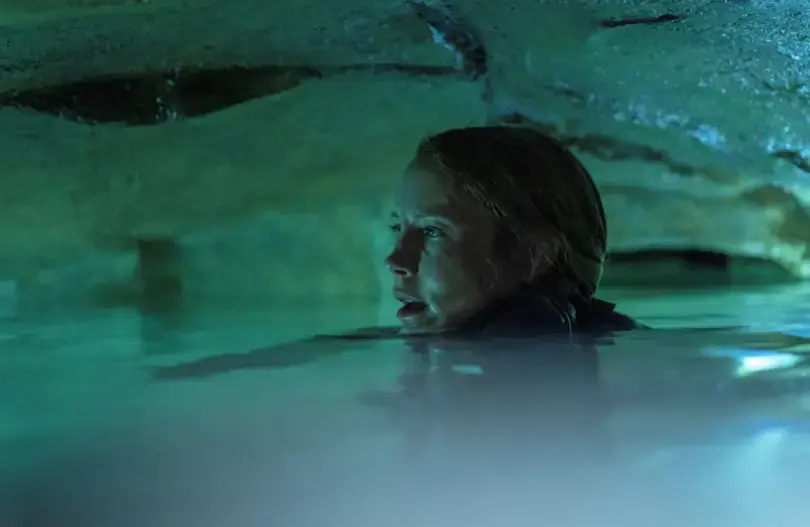
The credits of Breaking Surface roll right after one of the strangest final shots of any recent survival thriller: two sisters in white dresses, swimming in circles under the water like mermaids. After 80 minutes of cold, panic and running out of air, the ending leaves one question hanging. Did Ida actually survive, or is that last scene what happens after she dies?
Short answer: Ida does not die in the film. Here is the ending in detail, what the final scene means (it goes back to the childhood accident the film opens with), and why I read it the way I do.
Ending at a glance
Verdict from the film’s own images, not from a confirmed statement by the makers
Opens her eyes on the shore as a rescue helicopter arrives.
Freed from the rockslide and brings Ida ashore.
What happens in the ending
The accident the whole film is built on
To understand the ending, you have to go back to the beginning. Breaking Surface opens with an event from the sisters’ childhood: a diving accident in which the younger sister, Tuva, nearly drowned. Their mother blamed the older sister, Ida, for it.
Ida never put that behind her. It explains why she is so tense around Tuva, why she panics when the rockslide pins her sister to the seabed, and why saving her matters so much more than a normal rescue. In her mind, this is the second time she has failed to protect Tuva. The reviewers who describe the film’s emotional core point to exactly this: the thriller is about whether Ida can finally undo that moment.
Did Ida die?
No, and the film shows it. The last “real” image of the story is Ida opening her eyes, and in the same moment help arrives. A film that wanted you to believe she died would not give her that beat, and it would not bring in a rescue helicopter right behind it.
In my opinion, the film would have been better without that shot. Cutting to black on Ida lying motionless on the shore would have kept the ending open and made the last image hit harder. Showing her open her eyes answers the question for me, and it is the one place where the film plays it safe.
The doubt comes from how close it is. Ida skips safety stops on her way up, her body is pushed past its limit, and the film cuts away before anyone tells us she is fine. You never see a doctor or a hospital bed. That is deliberate: it keeps the tension until the last second.
But… there is the last scene. Dream or afterlife?
This is where the doubt comes back. The shot of the two sisters in white dresses is so unreal that it is easy to take it as Ida’s dying vision. That is a fair reading, but it is not mine. Here is why I think Ida is alive:
- The order is wrong for that reading. The eye-opening comes before the underwater scene. If it were a death vision, the film would normally show it while Ida is unconscious, not after she wakes up.
- Both sisters are in the final shot. Tuva is alive and well, so the scene can’t be Ida’s private afterlife.
- The helicopter is a concrete sign of rescue. The film gives us a way out in the real world right before the symbolic image.
The last scene explained: two sisters in white dresses
The final shot is not part of the story’s timeline. It is an image, not an event, and it works like a poem. Because the film began with the childhood accident, I read it as the answer to that scene: the same two sisters, the same water, and this time nobody is drowning. Here is how I read its pieces:
White dresses
White stands for innocence and a clean slate. The dresses take us back to childhood, before the accident and the blame, as if the sisters were starting over.
Mermaids
The water that nearly killed Tuva as a child, and nearly killed both of them now, is where they belong. They move in it freely, without tanks or panic.
The circle
Circling each other means a closed loop: nobody pulls, nobody is pinned, nobody is to blame. For the first time in the film, they are equals.
Synchronised swimming
Synchronised swimming only works if two people move as one. It is the opposite of the film’s earlier chaos, when the sisters were out of sync with each other.
The film’s real story is the bond between two half-sisters who were distant and strained when the trip began. The rockslide is the crisis that forces them to depend on each other. By the end, Ida has rescued Tuva and Tuva has rescued Ida, so the debt is paid on both sides. The last shot shows what that new bond feels like instead of explaining it with dialogue.
Water also works as a baptism here. Ida’s childhood trauma returns underwater, and the film ends with her moving through the same water without fear. The white dresses fit that idea of washing clean and starting again. In short: Tuva nearly drowned because of an accident Ida was blamed for, and the film closes with both sisters moving through the water as one. The guilt is gone.
An alternative reading
To be fair to the darker reading: the shot could be a dream or a vision, the peace Ida finds after saving her sister while her body suffers from decompression sickness, and the helicopter would then arrive too late. The film does not disprove this, because it never shows us a hospital or a confirmed recovery. But it requires ignoring the eye-opening and the rescue that come right before, and it treats a hopeful symbol as a tragic one. I think the film’s tone, which is about connection, points the other way.
What the ending says about the film
- Guilt and trauma: Ida was blamed for the childhood accident that almost drowned Tuva. Rescuing her now is how she works through that guilt, and the last shot is the release.
- Reciprocity: the rescue goes both ways, so neither sister owes the other anymore.
- Nature as indifferent, not evil: the fjord isn’t punishing anyone. It is simply cold, deep and indifferent, and only the sisters’ bond makes the difference.
Where to watch Breaking Surface
More movies like Breaking Surface
If the ending stayed with you and you want more survival thrillers where the air is running out, read my list of movies like Whalefall, or the movies like Fall 2: Deadpoint if you prefer survival on the surface. Note that Breaking Surface also got an English-language remake, The Dive (2023).
FAQ
Do Ida and Tuva both survive in Breaking Surface? Yes. Tuva is freed and brings Ida ashore, and Ida opens her eyes as a helicopter arrives.
What does the last scene mean? It is a symbolic image of the sisters reconciled. It echoes the childhood diving accident the film opens with: white dresses for innocence and a fresh start, circling and synchronised swimming for equality and harmony, and the water that almost killed them as a place of peace.
Why did Ida feel guilty? As a child she was blamed by her mother when Tuva nearly drowned in a diving accident. That guilt drives her behaviour throughout the film.
Is Breaking Surface based on a true story? I am not aware of a real event behind it, and I haven’t found a source that says so.