There is a particular kind of cinema that doesn’t explain itself. No establishing shots of the threat. No scientist delivering exposition about what we’re dealing with. No cut to a war room where generals stare at radar screens. Just a group of people, a camera, and something happening outside the frame that they can’t outrun.
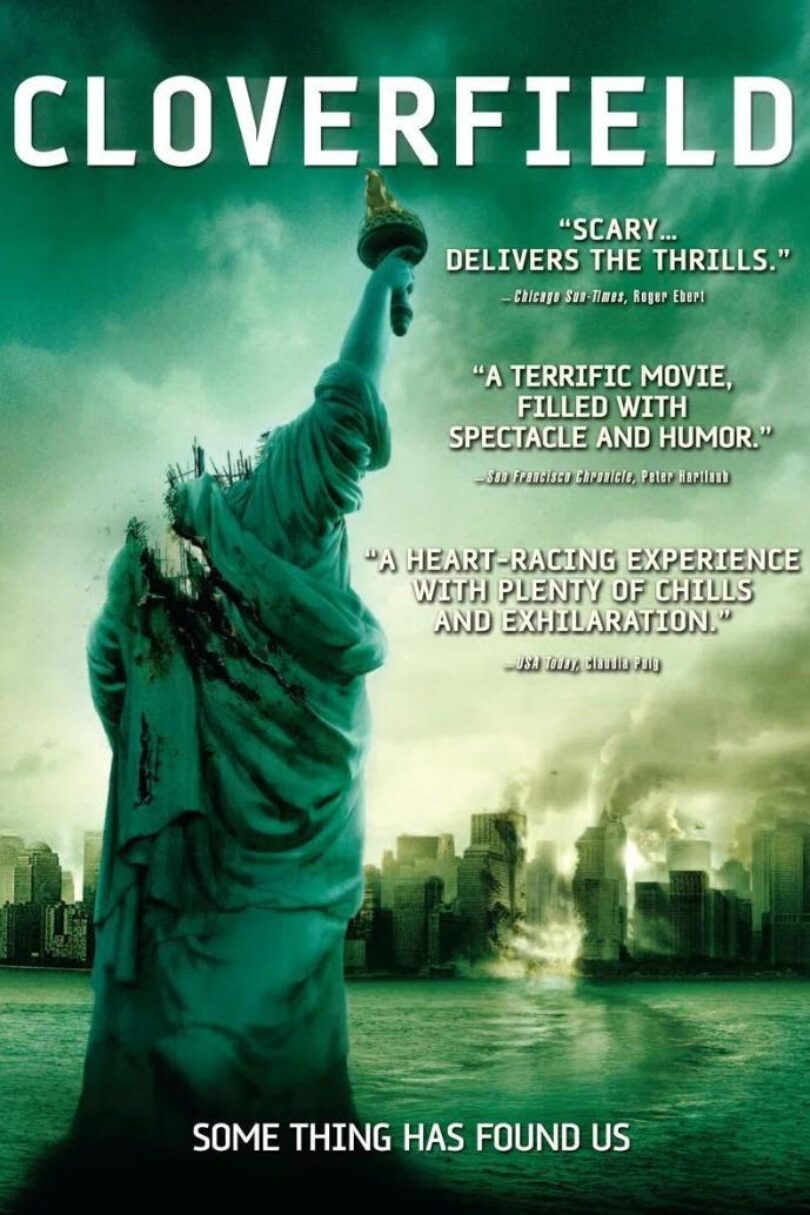
Cloverfield understood that instinct before most blockbusters were willing to try it. Produced by J.J. Abrams, directed by Matt Reeves — who would later make The Batman and War for the Planet of the Apes — and written by Drew Goddard, it arrived in January 2008 with almost no information attached to it. No title in the first teaser. No clear sense of what the film was. Just a release date and the image of the Statue of Liberty’s head rolling down a Manhattan street.
That marketing campaign was, in retrospect, the film in miniature: withhold the thing, and the imagination does the rest.
I find Cloverfield one of the most purely effective found footage films ever made — not because it is the deepest or the most formally inventive, but because it does exactly what it sets out to do with complete commitment and zero compromise. It puts you in New York on the worst night in the city’s fictional history, hands you a camera, and doesn’t let you look away.
Where to Stream Cloverfield?
What Cloverfield Is About
Rob Hawkins (Michael Stahl-David) is leaving New York for a job in Japan. His friends have thrown him a going-away party in a Manhattan apartment. His friend Hud (T.J. Miller) is filming the evening — testimonials, toasts, the usual chaos of a party that’s slightly more complicated than it should be, because Rob and his friend Beth (Odette Yustman) have a history that hasn’t been resolved.
Then something hits the city.
The power goes out. The ground shakes. Something enormous moves through Lower Manhattan. The Statue of Liberty’s head comes down the street. The party ends.
What follows is Rob, Hud, and a small group of friends attempting to cross a city that is coming apart — not because it makes strategic sense, but because Beth is still out there and Rob is not leaving without her.
The Cloverfield Trailer
Review: Cloverfield (Spoiler-Free)
The first thing Cloverfield gets right is the party. The opening twenty minutes — before anything goes wrong — are deliberately mundane. Friends arguing, drinks being poured, the low-level social tension of people who know each other too well. It is not the most gripping twenty minutes of cinema you will ever watch. It is, however, exactly what the film needs. By the time the ground shakes and the lights go out, you know these people. Not deeply — but enough. And that is enough.
What follows is one of the most sustained pieces of urban chaos ever put on screen. Matt Reeves and cinematographer Michael Bonvillain made a specific and difficult choice: to keep the camera in the hands of a character, at street level, with no access to information beyond what that character can see. No news broadcasts explaining the situation. No military briefings. No omniscient cut to the monster in full, framed against the skyline for maximum effect. Just Hud, running, filming, occasionally commentating in the way that people actually do when something incomprehensible is happening around them — a mixture of awe, terror, and the deeply human instinct to narrate.
The result is a film that puts you inside an event rather than showing it to you. The difference is considerable. Cloverfield doesn’t feel like a monster movie. It feels like being in one. The disorientation is the point. The fact that you never fully understand what is happening — where the creature is, what it wants, where it came from — mirrors exactly the experience of the characters. You are as lost as they are. I find that a genuinely radical choice for a studio blockbuster with a $30 million budget.
The found footage format earns its place here more than in almost any other big-budget film that has attempted it. The shaky cam is not a stylistic affectation — it is the argument. This is what it would look like. This is the footage that would exist. The film was edited to replicate the specific texture of a home video that has been partially taped over — glimpses of an earlier, happier day with Rob and Beth surface occasionally beneath the chaos, which adds an emotional undercurrent that the film never overplays.
Did you know?
- The first teaser trailer for Cloverfield was attached to screenings of Transformers in July 2007 — with no title, no cast, no plot description. Just a release date and the Statue of Liberty’s head hitting the street. The internet spent months trying to figure out what it was.
- The film was shot in just 34 days on a budget of $30 million — and made $170 million worldwide. It remains one of the most profitable found footage films ever made.
What Cloverfield shares with the best found footage films is an understanding that the camera is not a neutral observer. Hud keeps filming when he shouldn’t. The act of filming becomes its own kind of compulsion — the same compulsion that makes people reach for their phones during disasters, that makes witnesses document rather than intervene. Director Matt Reeves noted that the pedestrians photographing the Statue of Liberty’s severed head with their phones was entirely contemporary — a 2008 observation that has only become more accurate since.
The performances are naturalistic in the way that found footage demands — not showy, not theatrical, just people reacting to things. T.J. Miller as Hud is the film’s unlikely emotional anchor, his running commentary shifting from comedy to fear to something more vulnerable as the night progresses. Michael Stahl-David carries the rescue mission with a quiet stubbornness that never tips into heroism.
If Cloverfield has a weakness, it is that the emotional investment in Rob and Beth’s relationship — which the film needs you to feel in order for the third act to land — is established quickly and never fully deepens. The film is eighty-five minutes long and has a monster to deal with. There is only so much room. It is a trade-off the film makes consciously, and I think it makes the right call — momentum over depth — but it means the ending hits harder as spectacle than as grief.
The monster itself deserves mention. Designed to be glimpsed rather than displayed, it is one of the most effectively withheld creatures in blockbuster cinema — present throughout, never quite seen, always suggested by what it leaves behind. When you do finally see it clearly, it has already done its damage. That sequencing is precise.
Verdict
Cloverfield is the film that proved found footage could work at scale — that the format wasn’t limited to low budgets and dark corridors, that you could point a handheld camera at something enormous and make it more frightening than any conventional shot could manage.
Seventeen years later, it remains the best argument for what found footage can do when a studio actually commits to it.
If you’ve never seen Cloverfield on the largest screen available to you, you haven’t really seen it.
Where to Watch Cloverfield
Similar Films to Cloverfield
The Blair Witch Project (1999) — The film that made everything after it possible. No monster, no budget, no answers. Where Cloverfield shows you the chaos, Blair Witch withholds it entirely. Two opposite approaches to the same question: what is the camera not showing you?
REC (2007) — The purest found footage horror of its era. A Spanish apartment building, a camera crew, and something that moves faster than they do. Shares Cloverfield‘s relentless forward momentum and its refusal to let the audience breathe.
Trollhunter (2010) — The Scandinavian answer to the found footage creature feature. Less panic, more deadpan — but the same core idea: a camera pointed at something that shouldn’t exist. Read our full review.
War of the Worlds (2005) — Not found footage, but the closest Hollywood came to the same street-level disaster perspective before Cloverfield. Spielberg keeping the camera with the civilians, withholding the full picture. A direct ancestor.
10 Cloverfield Lane (2016) — The spiritual sequel, set almost entirely in a bunker. No handheld camera, no monster in the streets — but the same DNA, the same question of what is happening outside the frame. A completely different film that somehow belongs to the same universe.