After Host — one of the most efficient horror films of the decade — Rob Savage had considerable goodwill to spend on his next project. Dashcam spends it quickly, and not always wisely.
That’s not to say it’s a bad film. It’s a film with a specific vision, a deliberate provocation at its centre, and enough genuine scares to justify its 77-minute runtime. But where Host was lean, precise, and universally effective, Dashcam is chaotic, divisive, and built around a lead character designed to make you deeply uncomfortable — in ways that don’t always serve the horror.
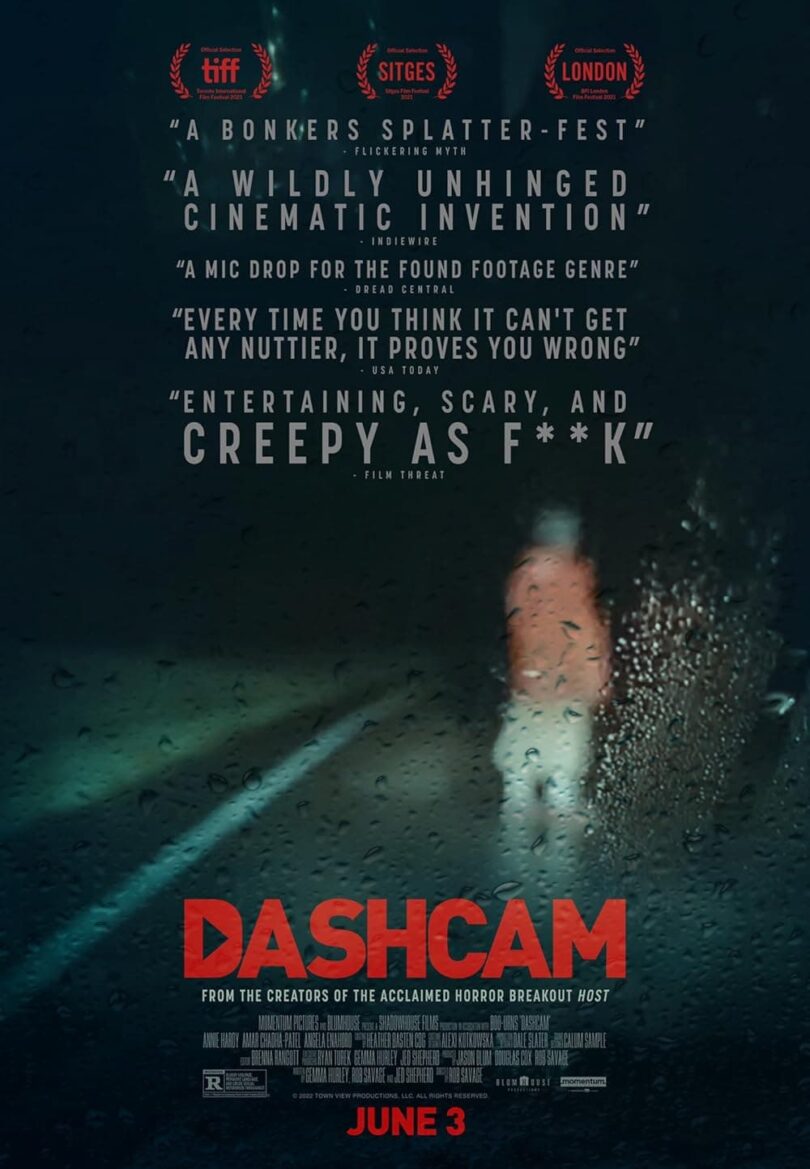
Directed by Savage and produced by Blumhouse, Dashcam premiered at the Toronto International Film Festival in September 2021 and received a theatrical release in June 2022. It has a 4.5 on IMDB — which tells you almost everything you need to know about how polarising it is.
Dashcam (2021)
The Story: A foul-mouthed American livestreamer visits London, steals her friend’s car, and agrees to transport a mysterious elderly woman to an unknown location. A terrible idea.
🎬 Our opinion: The scares work. The film doesn’t — not quite. Rob Savage’s follow-up to Host has real craft on display, but an intentionally obnoxious protagonist who makes it hard to care about anything that happens to her. Man, I really wanted to like this one.
Director: Rob Savage · Cast: Annie Hardy, Amar Chadha-Patel, Angela Enahoro
Watch it
Powered by JustWatchThe Story: What Dashcam Is About
Annie Hardy (played by a semi-fictionalised version of the real musician of the same name) is a foul-mouthed, anti-mask, MAGA hat-wearing livestreamer who improvises rap songs in her car using viewer comments as lyrics. Sick of COVID restrictions in Los Angeles, she flies to London to surprise her old bandmate Stretch (Amar Chadha-Patel).
Things go sideways quickly. Annie steals Stretch’s car, ends up at a mysteriously empty restaurant, and agrees — for money — to transport an elderly woman named Angela to an undisclosed location. Angela is not well. Angela is, in fact, something considerably worse than unwell.
What follows is a nightmarish drive through the English countryside, filmed entirely through Annie’s iPhone and the car’s dashcam, broadcast live to her online audience.
The Dashcam Trailer
Review: Dashcam (Spoiler-Free)
Let’s start with what Dashcam gets right — because it does get things right. Much of the film was improvised, with a rough outline guiding each day’s shooting, and that guerrilla energy translates to the screen. The horror sequences, when they arrive, are genuinely effective — visceral, fast, and occasionally deeply unsettling. Rob Savage knows how to construct a scare, and there are moments here that hit hard.
The format is also used intelligently. The live chat running alongside Annie’s stream provides a real-time Greek chorus — viewers reacting to events with the predictable mixture of disbelief, excitement, and casual cruelty that characterises online audiences. It’s one of the film’s sharpest observations, and it works.
The problem is Annie herself.
Did you know?
Annie Hardy is playing a semi-fictionalised version of herself — she is a real musician, frontwoman of the band Giant Drag, and an actual anti-mask, right-wing online personality. The character in the film is not far from the real person. Which makes the whole thing considerably more uncomfortable.
The decision to centre the film on a deliberately obnoxious, politically provocative character is clearly intentional — Savage wanted to make a horror film about a specific type of online personality, and Annie Hardy brings an authenticity to the role that no conventional actress could have replicated. The critical consensus notes that the film is “visually and thematically provocative, although the film’s grating protagonist undercuts its effectiveness.”
I find myself in agreement. I understand the choice. I even respect it as a creative decision. But understanding a choice and being carried along by it are two different things. The problem with an antipathetic protagonist isn’t that they’re unpleasant — horror is full of characters you don’t root for. The problem is that Dashcam gives you so little reason to care what happens to Annie that the stakes dissolve. When terrible things happen to her, the dominant emotion is not dread — it’s a kind of detached observation. The film registers as spectacle rather than experience.
That gap between what the film is trying to do and what it actually achieves is Dashcam‘s central limitation. It’s not a failure of craft. It’s a failure of connection.
Verdict
Man, I really wanted to like Dashcam. The concept is great, the director proved himself with Host, and the follow-up had every reason to work. But it just didn’t convince me. The scares work — Rob Savage knows exactly what he’s doing on a technical level. The film, though, never quite gets there. Craft without empathy only goes so far.
If Host made you a Rob Savage believer, Dashcam will test that faith — and whether it breaks depends entirely on your tolerance for spending 77 minutes with someone you’d cross the street to avoid.
Where to Watch Dashcam
Powered by JustWatchSimilar Movies to Dashcam
Dashcam sits at a crossroads between screenlife horror, social media satire, and found footage chaos. If one of those angles hooked you more than the others, here’s where to go next. And if the format itself is what drew you in, our guide to the The 11 Best Screenlife Movies — When the Screen Becomes the Stage goes much deeper.
Host (2020) — The film that earned Rob Savage the goodwill he spends on Dashcam. Six friends, a Zoom séance, 56 minutes, no exits. Where Dashcam is chaotic and provocative, Host is lean and precise — and considerably more frightening. The gold standard of pandemic horror. Read our full review.
Unfriended (2014) — A Skype call haunted by a dead classmate. The genre’s founding screenlife text, and still one of its most effective. Nastier than Dashcam, angrier, and built around a group dynamic that the format uses with real intelligence. Read our full review.
Spree (2020) — A rideshare driver livestreams his increasingly violent night for an audience that won’t stop growing. The closest companion piece to Dashcam in terms of social media satire and an intentionally repellent lead. Joe Keery is extraordinary. Not found footage in the strict sense, but the same DNA.
Creep (2014) — A videographer answers an online ad for a one-day job and slowly realises his client is not what he appeared. Found footage built almost entirely on performance and unease. Mark Duplass is one of the great horror performances of the decade. No livestream, no social media — just two people and a camera and the slow certainty that something is very wrong.