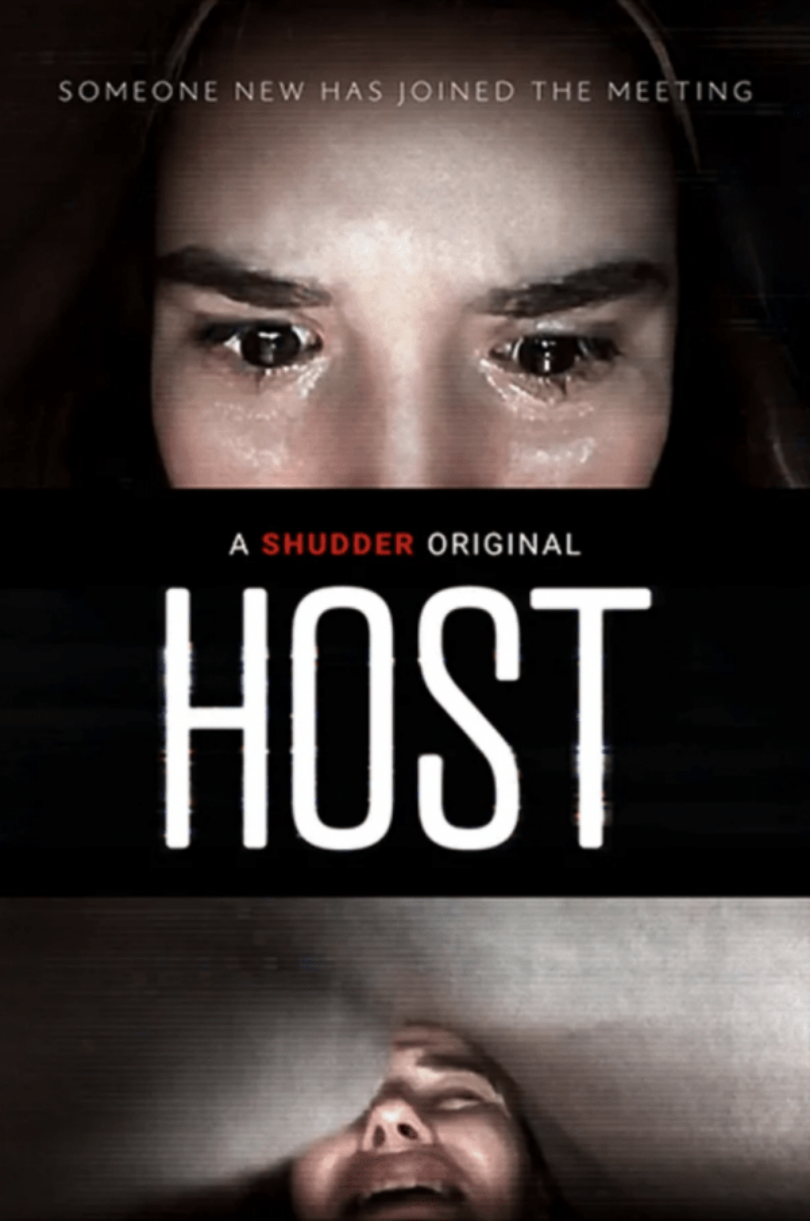
Host is a horror film shot entirely during the COVID-19 lockdown, set on Zoom, and running to just 56 minutes. All of which invites a reasonable suspicion: that what we’re dealing with is a novelty — a pandemic experiment held together by circumstance rather than craft.
That suspicion doesn’t survive the first act.
Where to Watch Host?
What Host Is About
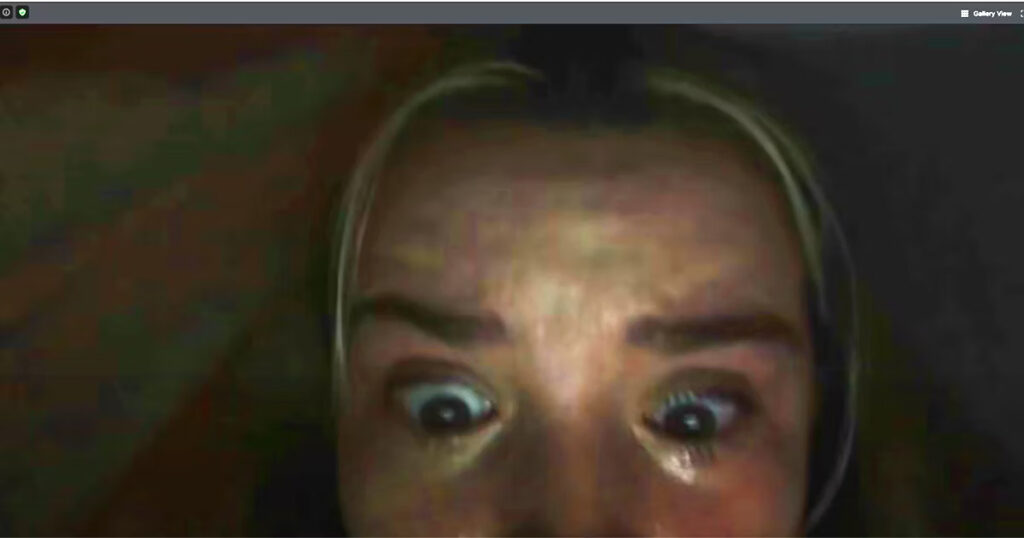
Six friends, stuck in quarantine, decide to hold a séance over Zoom. Haley (Haley Bishop) organises the call and brings in a medium, Seylan (Seylan Baxter), to guide them through it. What begins as something between boredom and curiosity turns dark almost immediately — an uninvited presence joins the call, and the evening stops being fun.
What follows is a fight to survive, conducted entirely through laptop cameras, across six separate screens.
The Host Trailer
Screenlife Horror — A Genre of Its Own
Host belongs to a subgenre that’s quietly become one of my favourite corners of found footage: the screenlife film. Every scene, every scare, every revelation unfolds on a character’s screen — no cutaways, no establishing shots, no omniscient camera. Unfriended and Searching are the genre’s most prominent landmarks. Host belongs in that company.
If the format is new to you, it’s worth reading our piece on the best screenlife films — it’s a rabbit hole worth going down.
A Horror Film Born from Lockdown
Host carries another distinction that’s easy to forget: it is, in the most literal sense, a COVID film. Shot entirely during the 2020 lockdown, with cast and crew working from their own homes, it didn’t just use Zoom as a stylistic choice — it had no other option. What’s remarkable is how little that shows.
The constraints of production become the constraints of the story, and the isolation that defined that particular moment in time becomes the film’s most effective source of dread. Watching it now, there’s an added layer of unease that no amount of set design could manufacture: the recognition of a world we all lived through, suddenly made frightening again.
Review: Host (Spoiler-Free)
What makes Host work — genuinely work, not just as a curiosity — is that it earns its scares. The setup is patient. The characters feel real, partly because the actors use their own names and improvised significant portions of their dialogue. I find that authenticity does most of the heavy lifting: you’re not watching characters, you’re watching people. And that distinction matters enormously once things go wrong.
The mundane texture of a Zoom call in 2020 is reproduced with uncomfortable accuracy — the frozen screens, the background filters, the slight audio delay. You know this world. You’ve lived in it. And that familiarity is exactly what the film weaponises.
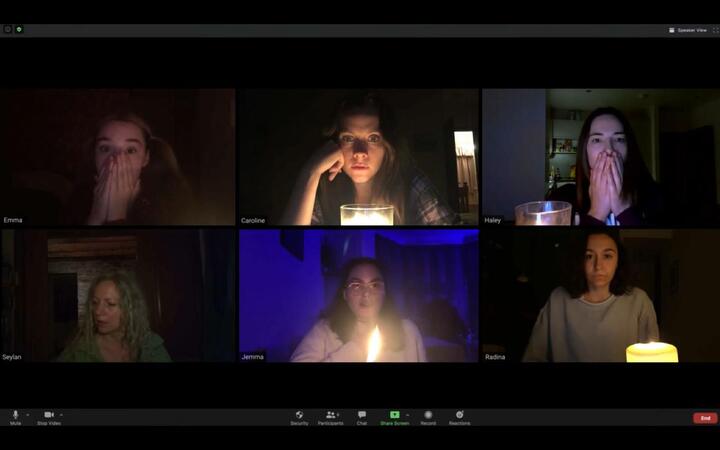
The technical constraints of the format, far from limiting the horror, become its engine. A virtual background that shouldn’t be moving. A filter that reveals something standing behind someone who is supposedly alone. What I find most impressive is how Host takes the tools of everyday digital life and makes them wrong — quietly, precisely, without telegraphing the scare.
The practical effects — achieved on a shoestring, during a lockdown, through laptop cameras — are more effective than they have any right to be. Several sequences produce genuine dread through the simplest possible means. Darkness. A door. Something that wasn’t there a moment ago.
The one limitation worth naming is the screenplay, which doesn’t aspire to much beyond the mechanics of its premise. Character depth is minimal, and the story doesn’t linger once the credits roll. But Host isn’t trying to be Hereditary. It’s trying to terrify you for 56 minutes — and on that count, I think it succeeds with room to spare.
As for the much-noted detail of characters carrying their laptops around the house: yes, it strains credibility. It also makes the film possible. Horror has always asked for a degree of suspended disbelief. Host asks for less than most.
And honestly? At 56 minutes, there simply isn’t time to get bored. In an era when every horror film seems to run two hours and earn maybe twenty minutes of it, that economy feels almost radical. You don’t need to plan your evening around it. You just need to be willing to keep the lights on afterwards.
Verdict
What Rob Savage built during a lockdown, with a Zoom call and a handful of willing actors, is one of the most efficient horror films of the decade. It’s lean, it’s smart, and it understands something many bigger productions forget: that the scariest thing in the room is often the thing you almost didn’t notice.
If you only have an hour — this is exactly how to spend it.
Where to Stream Host
Similar Films to Host
Unfriended (2014) — The genre’s founding text in this format. A Skype call haunted by a dead classmate. Nastier, angrier, and still remarkably effective.
Searching (2018) — Less horror, more thriller, but the same screen-as-window logic. John Cho searching for his missing daughter through her digital life. Devastating.
Unfriended: Dark Web (2018) — The follow-up trades ghosts for something more grounded and arguably more disturbing. A laptop found in a coffee shop, and what’s on it.
REC (2007) — Back to the found footage roots. A Spanish apartment building under quarantine. Still one of the scariest films in the genre.
Paranormal Activity (2007) — The film that proved you don’t need a budget to make an audience leave the lights on. Essential viewing for anyone interested in what found footage can do.