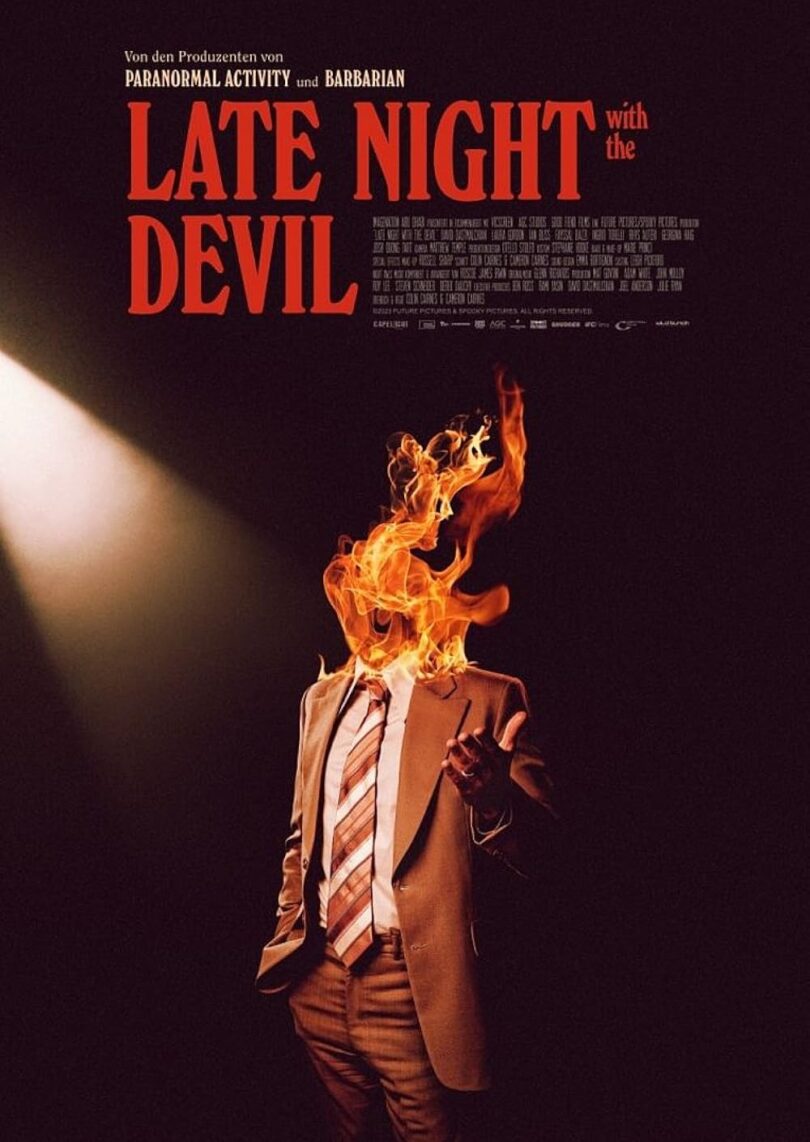
Man, there’s something about a late night talk show. The warm studio lights, the band playing the host in, the audience laughing at jokes you barely understand. It just feels… safe. Like being a kid at your grandparents’ house, way past your bedtime, wrapped in a blanket — and your grandparents actually letting you stay up to watch. That little feeling of privilege. Of being trusted with something slightly too grown-up for you. It just feels good, and that’s kinda what Late Nite with the Devil is: A “feel good horror movie”. Huh? How is that possible?
Directed by Australian brothers Colin and Cameron Cairnes and premiered at SXWW in 2023, Late Night with the Devil is one of the most formally inventive found footage films in years — a movie that doesn’t just use the format as a stylistic choice but builds its entire architecture around it. The result is something genuinely rare: a horror film that earns its scares through craft rather than volume.
Where to Stream Late Night with the Devil?
What Late Night with the Devil Is About
It is Halloween night, 1977. Jack Delroy (David Dastmalchian) is the host of Night Owls — a late night talk show that has spent six seasons running a distant second to Johnny Carson’s Tonight Show. Ratings are down. His wife Madeleine died of cancer the previous year. His career is slipping.
Tonight, he has planned something special. A Halloween episode built around the occult — a psychic, a sceptic, a parapsychologist, and her subject: a young girl named Lilly, the sole survivor of a Satanic cult, who may or may not be demonically possessed.
What we are watching, framed as recovered footage from that broadcast alongside behind-the-scenes material shot during commercial breaks, is the night that Night Owls made television history — for all the wrong reasons.
The Late Night with the Devil Trailer
Review: Late Night with the Devil (Spoiler-Free)
The first thing Late Night with the Devil gets absolutely right is its world. The grainy multi-camera broadcast aesthetic, the period costuming, the studio lighting that feels like it belongs to a different era of television — every detail is considered. Within the first ten minutes you are not watching a horror film set in 1977. You are watching a 1977 television broadcast.
And for a while — surprisingly long, actually — it feels good. Almost cosy. The guests are entertaining, the host is charming, the audience is laughing. There’s a warmth to the whole thing that you don’t expect from a horror film. I’d almost call it feel-good horror — the kind of film that lulls you into a genuine sense of comfort before pulling the rug. The subtitles, the fake commercials, the period-accurate graphics — all of it adds to the illusion. You’re not watching a film. You’re watching a broadcast. Nostalgic. The good old times. Making you feel a child again.
That’s the feeling it gave me – even though i wasn’t even born in 1977!
That distinction matters enormously, because the horror that follows depends entirely on you believing in the world before it starts to fall apart.
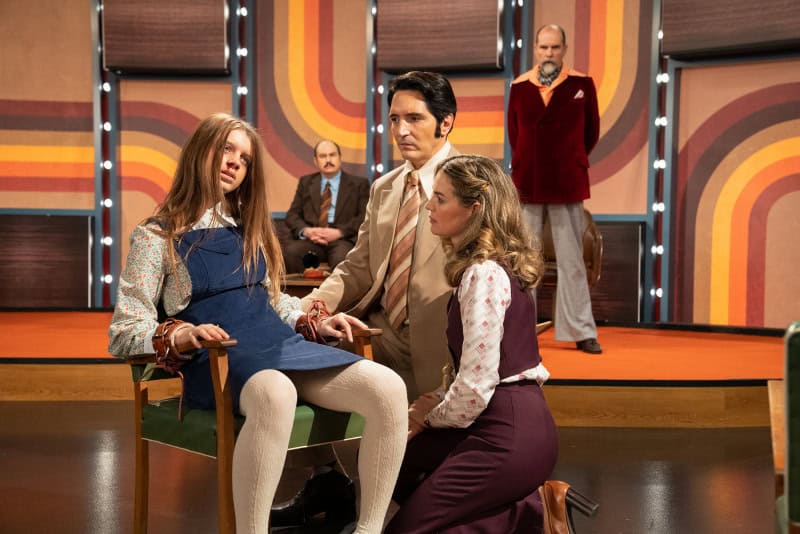
David Dastmalchian is the reason it works as well as it does. Jack Delroy is a specific and difficult character to play — charming enough that you root for him, desperate enough that you worry about him, and ambiguous enough that you’re never entirely sure how much of what you’re watching is performance and how much is genuine. Dastmalchian holds all of that simultaneously without ever tipping his hand. It is the kind of performance that carries a film and makes it look effortless. Does he do it for the ratings? Or because he believes it? Because of love? Or for glory?
The supporting cast is strong across the board. Ian Bliss as Carmichael Haig — a sceptic in the mould of James Randi, brought in to debunk the evening’s supernatural claims — provides the film’s sharpest dramatic tension. His scenes with the psychic Christou (Fayssal Bazzi) have a wit and energy that the film is smart enough to lean into before pulling the rug. And Ingrid Torelli as Lilly — the possessed girl at the centre of the evening’s main event — is quietly unsettling in a way that builds slowly and then, in the film’s third act, stops being quiet at all.
Did You Know?
- On its opening Sunday in the US, Late Night with the Devil grossed exactly $666,666 at the box office. Whether that was engineered by the distributor or a genuine coincidence has never been confirmed — but it’s hard to imagine a better opening weekend number for a film about a deal with the devil.
- The film was made in Australia by two Australian brothers — Colin and Cameron Cairnes — but is set entirely in 1970s America. Every detail of the period, from the studio lighting to the costumes to the broadcast aesthetic, was constructed from scratch.
- Stephen King publicly praised the film, saying it was a movie he couldn’t take his eyes off. For a found footage horror film made on a modest budget, that kind of endorsement doesn’t happen often.
- Three briefly featured still images in the film were generated using AI, which sparked a significant debate in the film community. The Cairnes brothers acknowledged the use and stated they had experimented with only those three images.
What I find most impressive about Late Night with the Devil is its patience. The film knows that horror landing in a familiar, comfortable setting hits harder than horror arriving in an already frightening one. So it spends its first half being genuinely entertaining — the talk show format is used with real wit, the guests are interesting, the dynamic between Delroy and his producer Leo (Josh Quong Tart) adds texture without slowing things down. By the time the evening starts to go wrong, you are invested in the show itself. You want it to succeed. That investment is precisely what the film uses against you.
The horror isn’t that hard — I’d actually recommend this to non-horror fans. Not overdone, not shocking, just plainly entertaining, like what a late night show should be. And when the horror does arrive — and it does arrive — it commits fully. There is a moment in the third act involving worms that I will not describe further, except to say that I respected it enormously for going exactly where it needed to go. The film earns its R rating without wallowing in it.
Verdict: A Feel-Good Horror Movie
Late Night with the Devil is the rare horror film that trusts its audience enough to take its time. It starts warm — almost nostalgic, like a childhood memory of staying up too late watching television — and uses that warmth as a weapon. By the time the comfort turns to dread, you’re already too invested to look away.
I’ll be honest: it’s not particularly scary. There are almost no jump scares that will keep you up at night — the horror here is slow and creeping rather than sudden and brutal. You feel it more than you fear it. Almost. What it is instead is consistently entertaining — witty, atmospheric, and building a quiet unease that sits somewhere between genuine dread and morbid fascination.
It is also, I’d argue, one of the most intelligent uses of the found footage format since The Taking of Deborah Logan — a film that understood, as this one does, that the camera doesn’t just record what happens. Sometimes it is the reason it happens at all.
If you think found footage has run out of ideas, Late Night with the Devil will change your mind — and probably keep you away from late night television for a while.
Is Late Night with the Devil Found Footage?
Strictly speaking — it depends on your definition.
The film uses a professional multi-camera live broadcast rather than a single handheld camera. But the foundational conceit is pure found footage: we are watching material that was never supposed to be seen this way. A broadcast that went wrong. Behind-the-scenes footage that was never meant to air. Recovered evidence of something terrible.
I’d place it alongside Ghostwatch (1992) — a BBC broadcast that used television grammar to achieve the same effect found footage achieves with a shaky cam. Different aesthetic, same logic. By the way, both are featured in our article about the best found footage movies for Halloween.
However, it is not pure footage: Ther is also a short documentary prologue that contextualises the broadcast before we watch it. Some say that “breaks” the found footage side -but honestly, that doesnt bother me at all. It contextualizes the whole thing, before the moei really starts. Doesn’ blunt the impact for me!
So yes — it is found footage and belongs here. Just don’t expect Blair Witch.
🕯️ Want the full breakdown?
If you’ve already watched it and want every detail explained — The Grove, the deal, Madeleine hidden in the frames, and what Jack actually stabbed — our full explained article goes deep. Don’t click if you haven’t seen the movie, this link contains spoilers.
→ [Ending, Symbols & The Grove — Late Night with the Devil Explained]
Where to Watch Late Night With The Devil
Similar Films to Late Night with the Devil
The Taking of Deborah Logan (2014) — The closest comparison on this list. A documentary crew filming an Alzheimer’s patient slowly realises something else entirely is taking hold. The same slow build, the same use of a camera crew as witness, and a final act that goes to places you won’t see coming. The gold standard of possession found footage.
Ghostwatch (1992) — The film Late Night with the Devil owes the most to, whether it acknowledges it or not. A BBC live Halloween broadcast investigates a haunted house — and goes catastrophically wrong. Made for television, presented as real, and so convincing that it caused genuine public panic in the UK. Essential viewing as a genre artifact and still deeply unsettling today.
[REC] (2007) — A different format but the same core idea: a camera that was supposed to document something routine instead captures something that should never have been seen. Relentless where Late Night is patient, but the DNA is shared.
Videodrome (1983) — David Cronenberg’s body horror masterpiece about a television executive who discovers a broadcast signal that begins to alter reality. No found footage, no talk show — but the same obsession with what television does to the people who make it and the people who watch it. Darker, stranger, and completely essential.
The Eyes of Tammy Faye (2021) — Not horror, but hear me out. A true story about the performance of sincerity on television, the hunger for ratings, and what people sacrifice for the camera. Watching it after Late Night with the Devil reframes both films considerably.